The Per-Tenant Boundary Is the Product, in Agents Ops environments
TL;DR: OpenAI’s Dots, Meta’s Muse, and xAI’s Grok Bot all shipped the same shape: an always-on agent with its own cloud computer, browser, and logins. Individually that’s a consumer product. At enterprise scale — one such agent per tenant, acting on that tenant’s systems — it is a multi-tenant governance problem, and the problem is the boundary, not the agent. I built the answer as a product. EyWALink AgentOps is the per-tenant ops boundary: a self-hosted observability stack plus an agentic ops team that monitors, diagnoses, reproduces in sandbox, hot-fixes, regression-tests, and deploys — every cross-tenant hop machine-enforced, audited, and inside the tenant’s own infrastructure.
Three labs, one shape
In the last few weeks the frontier labs converged on the same agent. Not a chatbot, not a copilot that suggests — a persistent agent that owns a machine:
| Lab | Product | What it is | The shape |
|---|---|---|---|
| OpenAI | Dots | Always-on agents that keep working after the session ends; the primary dot has its own cloud computer and browser | Persistent agent + its own machine |
| Meta | Muse | A secure, private personal agent that works toward a goal across everyday tasks | Persistent agent + its own context |
| xAI | Grok Bot | A team of always-on AI teammates, each on its own cloud computer, that sign into your apps and never log off | Persistent agent + its own machine |
The convergence is the point. All three ran different consumer pitches over the same underlying architecture: an agent granted a machine and a set of credentials, then left running. The machine is what makes the agent capable — and what makes it a security surface.
Last month’s post made the case that this is exactly where enterprise agent security lives: the moment an agent holds a scoped key, a shell, and a shared host, it has several ways to skip every permission layer the application asked for. The fix is to move tenant separation from something the software requests to something the operating system enforces — a six-rung isolation ladder, and the kernel-enforced rungs are the ones that hold.
Per-user is a consumer product. Per-tenant is a governance problem.
The labs frame their agents for a single user: your machine, your logins, your goals. That framing dissolves the moment you run the pattern at the unit an enterprise actually buys in — the tenant.
An enterprise does not buy “an agent.” It buys “an agent team that runs my systems.” One tenant’s agent team that can monitor, diagnose, and hot-fix the tenant’s production stack is, structurally, the same machine the labs shipped — except now:
- It runs unattended. A consumer agent works while you watch. An ops agent works while nobody is in the room. The audit trail is the only witness, so the trail has to be tamper-evident and distinguish what ran while nobody was watching from what a person drove.
- It holds credentials to production. Not a browser login — scoped keys to the tenant’s models, databases, and deployment targets. The blast radius of one mis-scoped key is the tenant’s whole system.
- It must not reach a sibling tenant. The instant two tenants share a control plane, the boundary the kernel enforces is the product. If tenant A’s ops agent can read tenant B’s model weights, telemetry, or hot-fix, the trust the enterprise buys collapses for every tenant at once.
That last bullet is the entire argument. The agent is a commodity. The boundary is the deliverable.
AgentOps: the per-tenant ops boundary made concrete
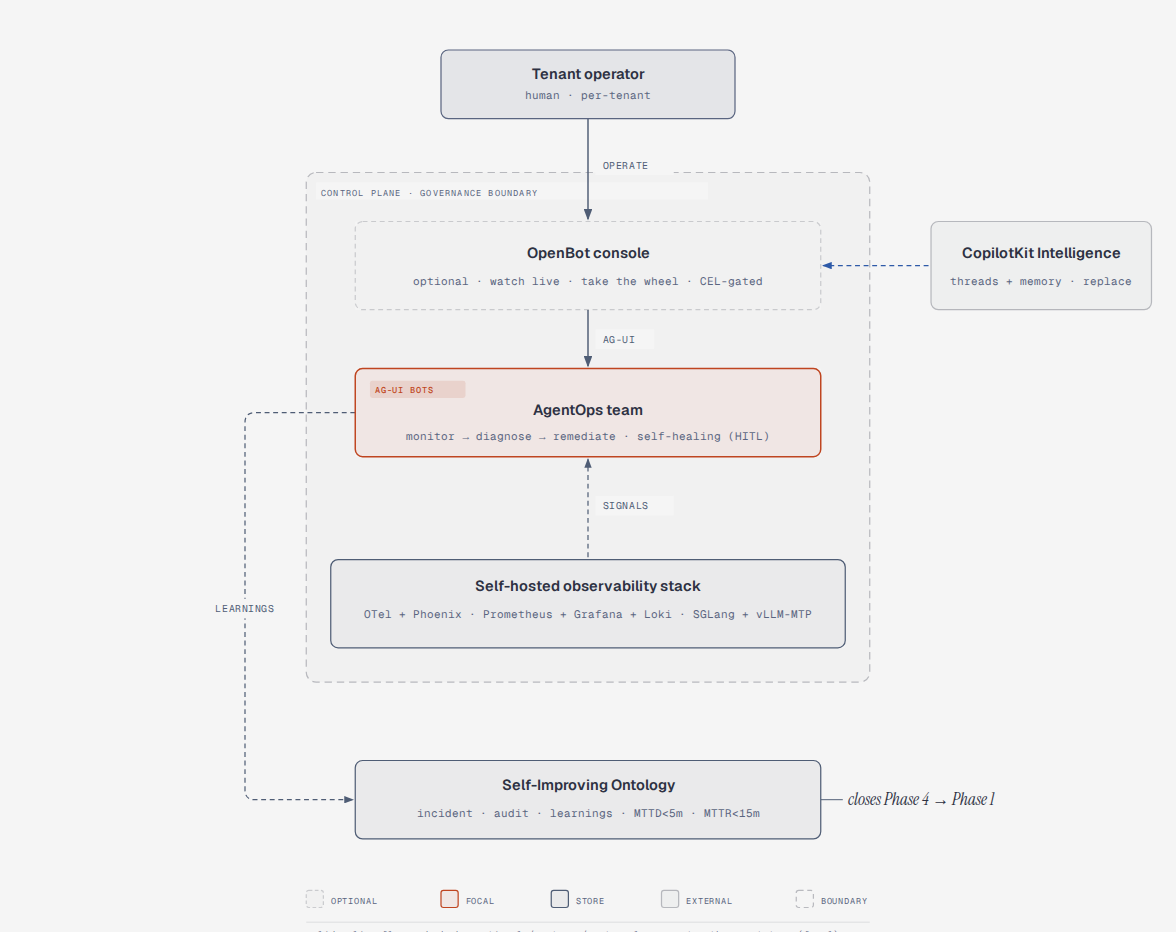
I incorporated the boundary idea into a product, EyWALink AgentOps, because an agent team that operates systems is the hardest place to get the boundary right: it has write access to production by design, and it runs without a human in the loop.
eywalink-agentops-archimate.puml
agentops-diagram-design.html · agentops-diagram-design.svg
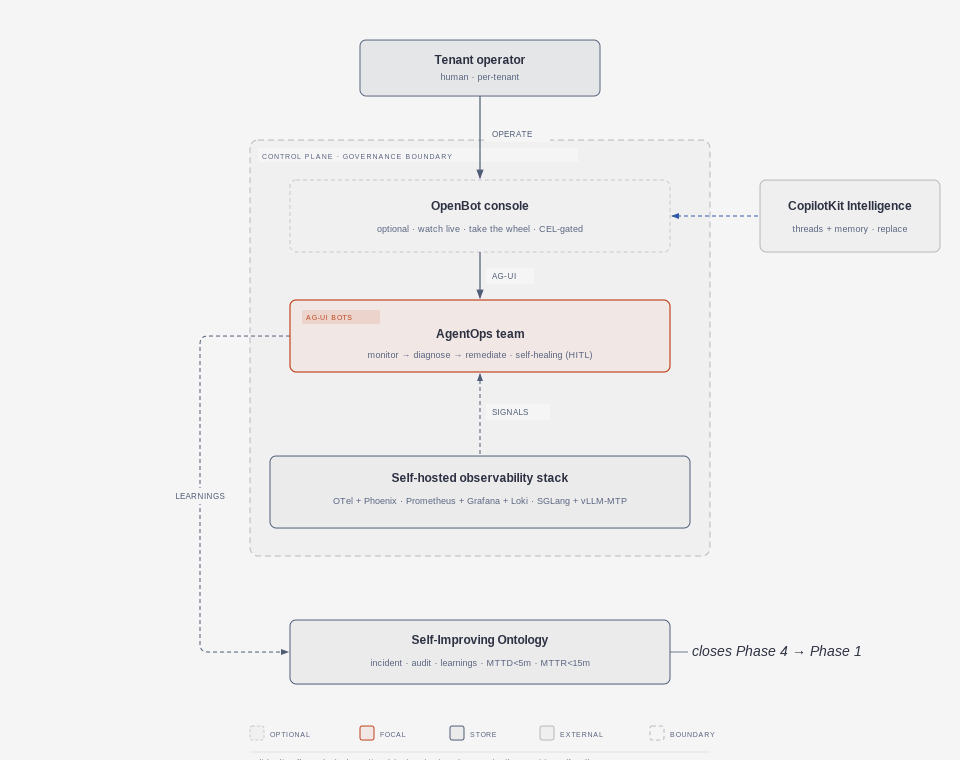
AgentOps is the “Operate & Improve” phase of a running agentic system. Two halves:
1. A self-hosted observability stack. OTel Collector for telemetry, Phoenix for LLM-call tracing, and a Prometheus / Grafana / Loki stack for metrics, dashboards, and logs. Model health, GPU utilisation, inference latency, and agent failures become first-class signals. The stack is open source and runs on the client’s own hardware — single GPU to multi-node, air-gapped or VPC. Telemetry never leaves the tenant’s infrastructure. No third-party monitoring SaaS.
2. An agentic ops team on top. The agents monitor the fleet, detect anomalies as statistical deviation from a baseline, reproduce the incident in a sandbox, hot-fix, regression-test, deploy the fix, then write what they learned back into the knowledge graph. The loop closes: production no longer means an SLA-breaching bug goes unfixed.
The target operational metrics come straight from the plan: MTTD under 5 minutes, MTTR under 15, 100% of agent spend tracked, over 90% alert true-positive rate, and more than half of incidents auto-resolved.
The boundary is not a feature bolted on. It is the architecture:
| Boundary requirement | Where it lives in AgentOps |
|---|---|
| Per-tenant isolation | One deployment per tenant — hard isolation, not a shared-DB tenancy. The tenant’s agents, models, and telemetry sit inside that tenant’s own stack. |
| Machine-enforced identity | The ops agents act inside the control plane’s multi-tenant governance boundary; a scoped identity per tenant, not a shared host account. |
| Fail-closed actions | Every agent action resolves target → evaluates policy → writes an audit row → then runs. Missing policy permits nothing; a broken rule denies. |
| Audited, unattended-safe | Every permitted, refused, and failed action is on the record, and each row carries who initiated it — person, routine, or the agent itself — so the trail separates attended from unattended work. |
| Secrets stay out of the transcript | Credentials are stored write-only, encrypted at rest, never returned by the API; the audit records that a secret was requested and its length, not its value. |
| Egress control | Each agent’s outbound connections pass a filter proxy; cloud metadata addresses are refused in every mode. |
The console: a human takes the wheel at the high-blast-radius point
A per-tenant ops boundary still needs a human who can read the numbers standing behind escalation, budget, and termination. AgentOps gives the tenant operator a console — a per-tenant add-on built on OpenBot — through which the operator talks to their ops team, watches it work on a live browser, and takes the wheel the moment the agent reaches a login or a step with too much blast radius.
That is the high-blast-radius gate as a UX. While a person is driving, the agent’s actions are refused, not queued. Routines cover the unattended middle: “check the inference queue every 30 minutes and post a summary” runs as a scheduled, owner-scoped, fatigue-guarded routine, and its audit rows are marked so the trail shows it ran with nobody watching.
One constraint up front: OpenBot is effective as the interaction + governance layer, but it is not an AIOps engine — no observability integration, no anomaly detection, no runbooks. The agent team on the observability stack stays the automation core; OpenBot slots in as the tenant-facing console, and the AgentOps agents register as remote Bots on its protocol. The one dependency to de-risk first is its managed-intelligence backend, which has to be replaced with the local stack before the “zero data leakage, on-client hardware” claim holds.
What this doesn’t solve
- Cost attribution to outcomes. You can price an agent action; you still cannot show a board what a tenant delivered per dollar the way a CFO accepts.
- Cross-tenant federation. The moment relationships span tenants, the isolation ladder has to be re-applied at the federation boundary. Per-tenant deployment isolates the ops boundary; it does not federate tenants.
Conclusion
Three frontier labs shipped the same agent and called it a product. Run it per tenant and the agent stops being the product — the boundary is. The labs solve for a single user’s machine. An enterprise needs a machine that cannot reach its siblings, that is audited while unattended, and whose telemetry never leaves the building.
AgentOps is that boundary across the whole ops lifecycle: monitor, diagnose, reproduce in sandbox, hot-fix, regression-test, deploy, learn. The model is a commodity. The per-tenant ops boundary is the thing you sell.
If you run more than one tenant on a shared control plane and your ops agents can see each other’s systems, ask the same question as last month’s post: which tier is your stack actually enforcing? The labs answered it for a consumer. You have to answer it for a tenant.
Related posts
- From a Security Incident to Reconsidering Enterprise Agent Boundaries — the cross-tenant incident that exposed the gap, and the isolation ladder this post builds on.
- Manage Your AI Agents at Enterprise Scale — governance, budgeting, and escalation patterns that keep an agent population from outgrowing the boundaries you set.